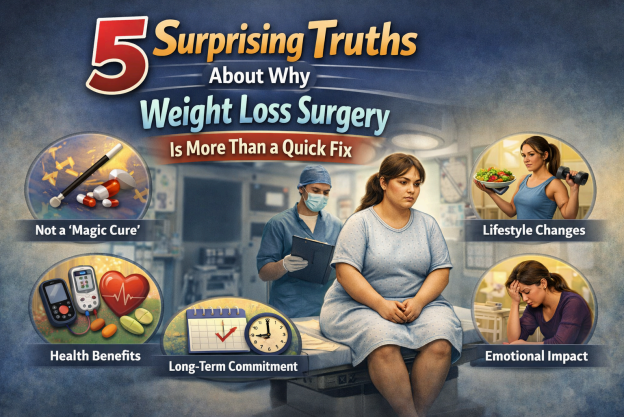
5 Surprising Truths About Why Weight Loss Surgery Is More Than a Quick Fix
1. The Invisible Barrier to Weight Loss
For many individuals battling obesity, the journey is defined by a exhausting cycle of hope
followed by profound frustration. You may feel like you are doing everything right—sacrificing
your favorite foods, adhering to grueling exercise regimens, and strictly avoiding processed
calories like biscuits, chocolates, cakes, french fries, chips, and burger bread. Yet, despite this
discipline, the "yo-yo" effect takes hold, and the weight inevitably returns.
This happens because obesity is not a failure of character or a lack of willpower; it is a complex,
chronic medical condition. Recent clinical insights suggest that the body possesses an internal
"metabolic set point" that acts as an invisible barrier. When we attempt to lose weight through
traditional means, the body often perceives the calorie deficit as a threat to its survival. It
doesn’t just resist the change—it actively fights back. Understanding this biological reality is the
first step in moving beyond the stigma of weight loss surgery and recognizing it as a
sophisticated tool to reset a broken system.
2. The Hidden Link Between Obesity and Cancer
While our culture often discusses weight through the lens of aesthetics, the clinical reality is far
more urgent. Obesity is a systemic condition that places a relentless strain on nearly every
organ. Beyond the well-known risks to the heart, it manifests in daily life as debilitating
co-morbidities: excessive snoring, severe back ache, chronic obstructive pulmonary dysfunction
(COPD), and advanced fatty liver disease.
Perhaps most alarming is the direct link between high body mass and an increased risk of
specific, life-threatening cancers. Clinical data indicates that obesity is a primary risk factor for a
list that "goes on and on," including breast cancer, endometrial cancer, and pancreatic cancer.
Bariatric surgery, therefore, serves as a critical preventative measure.
"The list goes on and on... kidney problems, cancer risk, breast cancer, endometrial cancer,
pancreas cancer... it impacts the lungs, kidneys, and heart."
By reducing excess weight, surgery helps lower systemic inflammation and recalibrates
hormonal imbalances, offering a level of protection against cancer that diet alone often cannot
provide once the body has reached a certain threshold of obesity.
3. Understanding the "Metabolic Set Point"—Why Diets Often Fail
Why is sustained weight loss so biologically difficult to achieve? Dr. Phani Krishna explains that
the body’s "metabolic set point" is essentially a thermostat for weight that the body strives to
maintain at all costs.
The Body’s Defense Mechanism When you engage in periods of intense fasting or extreme
exercise, your body doesn't just burn fat—it adapts. It becomes incredibly efficient at lowering
its metabolism to preserve its stores.
The Resistance Factor Essentially, the more you push, the more the body "protects" itself by
slowing its engine. This makes long-term, significant weight loss nearly impossible through
lifestyle changes alone once the set point is established at a high level.
The Scientific Thresholds To determine when the body has reached a point where surgery is no
longer an "option" but a necessity, clinicians use specific BMI (Body Mass Index) markers:
●BMI of 32.5 or higher: Surgery is indicated if the patient suffers from co-morbidities such as Type 2 diabetes, hypertension, high cholesterol, severe back pain, or obstructive sleep apnea.● BMI of 37.5 or higher: At this level, surgery is scientifically backed as a primary intervention even in the absence of other symptoms, as the risk to long-term survival is significantly elevated.
4. The "Diabetes Reversal" Mechanism
One of the most transformative aspects of "Metabolic Surgery" is its ability to not just manage,
but reverse Type 2 Diabetes.
To ensure the procedure is appropriate, clinicians perform sophisticated blood work, checking
both insulin and C-peptide levels. This allows them to confirm a diagnosis of Type 2
Diabetes—driven by peripheral insulin resistance—rather than Type 1, which is a lack of insulin
production.
A Functional Chemistry Shift Unlike traditional medicine that focuses on managing blood sugar,
surgery creates a "functional" change in the body’s chemistry. By altering the digestive tract,
procedures like the Gastric Bypass change the hormonal signaling of the gut. This directly
addresses insulin resistance at its source, allowing the body to utilize its own insulin effectively
once again.
Living a Disease-Free Life For the vast majority of patients, this leads to a complete reversal of
the disease. The transition from a life of daily injections and medication to a "disease-free"
status is perhaps the most profound outcome of the metabolic approach.
5. Restrictive vs. Malabsorptive—It’s Not Just a Smaller Stomach
Bariatric surgery is often oversimplified as "shrinking the stomach." In clinical practice, the
choice of procedure is tailored to the patient's specific metabolic profile:
● Restrictive Procedures: These include the Sleeve Gastrectomy. The primary mechanism is reducing stomach capacity, which limits food volume and impacts hunger-regulating hormones.● Malabsorptive (Powerful) Procedures: These include the Roux-en-Y Gastric Bypass, One Anastomosis Gastric Bypass (OAGB), and Mini Gastric Bypass.
These are considered "powerful" procedures because they combine restriction with a change in
how the body absorbs nutrients and calories. These interventions are particularly effective for
patients dealing with morbid obesity, severe fatty liver, and high cholesterol, as they provide a
more aggressive correction of the body’s metabolic pathways.
The Surprising Speed of Recovery
The image of a bariatric patient being bedridden or wheelchair-bound post-surgery is a total
myth. Thanks to modern, minimally invasive techniques, the recovery timeline is remarkably
fast.
"Quality of life improves... the patient can be active shortly after the procedure. If working from
home, they can return to work very quickly."
In fact, most patients are encouraged to be up and walking on the same day as their surgery.
While the physical return to daily activity is rapid, the long-term medical commitment is
paramount. Because powerful malabsorptive procedures change how you process nutrients,
patients must adhere to lifelong follow-ups and daily supplementation of Calcium and Vitamin
B12 to ensure their new, high-functioning metabolism remains healthy.
Conclusion: A New Perspective on Metabolic Health
We must shift the narrative. Weight loss surgery is not a "last resort" for those who have failed;
it is a life-saving tool for those whose biology is fighting against them. By addressing the
"metabolic set point" and reversing conditions like Type 2 Diabetes and hypertension, these
procedures do more than change a silhouette—they extend the human lifespan.
If you recognize yourself in the struggle—if you are battling excessive snoring, chronic back pain,
or the rising numbers of a BMI over 32.5—the most actionable step you can take is to stop
blaming your willpower and start consulting the science. Calculate your BMI, speak to a
specialist, and view metabolic health as a proactive choice rather than a reactive one.
Metabolic surgery is not merely an intervention for weight; it is a gateway to the disease-free
life that your biology was previously preventing you from reaching.