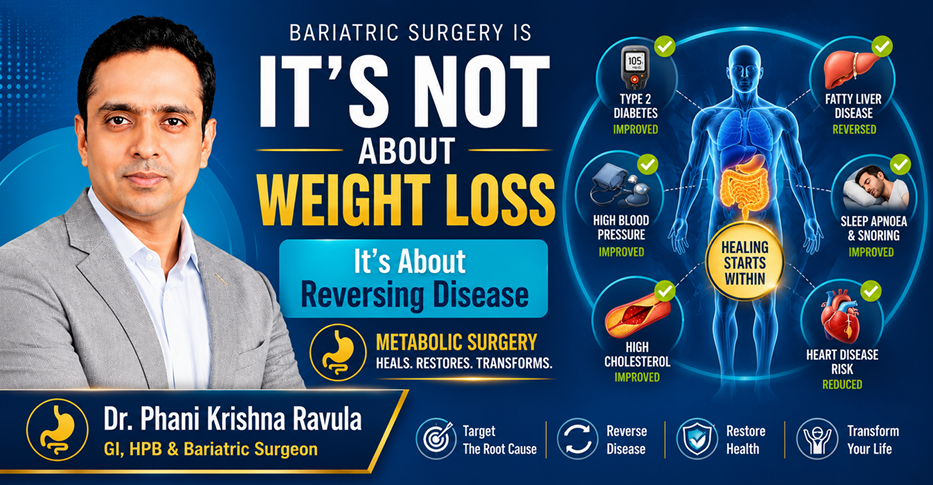
Metabolic Surgery vs Weight Loss Surgery: Why Bariatric Surgery Is About More Than Losing Weight
Bariatric Surgery Is No Longer Just Weight
Loss Surgery: Here's What I Tell My
Patients
One of the biggest misconceptions I encounter in my clinic is that bariatric surgery is only meant
for people who want to lose weight.
Almost every week, I meet patients who tell me the following:
"Doctor, I know I'm overweight, but I don't want surgery just to lose a few kilos."
What many people don't realise is that modern bariatric surgery is no longer simply about
weight loss.
In fact, we increasingly refer to it as metabolic surgery because its benefits go far beyond
reducing body weight.
When performed in the right patient, it can improve or even reverse many obesity-related
diseases that significantly affect quality of life and long-term health.
Obesity Is More Than a Weight Problem
When most people think about obesity, they think about appearance.
As doctors, we think about the diseases that obesity silently creates.
Some of the most common obesity-related problems I see include:
● Type 2 Diabetes
● High Blood Pressure
● High Cholesterol
● Fatty Liver Disease
● Heart Disease
● Increased Risk of Heart Attack
● Increased Risk of Stroke
● Knee Pain
● Back Pain
● Breathing Difficulties
● Obstructive Sleep Apnea
● Heavy Snoring
● Need for Night-Time Oxygen Support
Obesity is also associated with an increased risk of several cancers.
The reality is that obesity can affect nearly every organ system in the body.
That is why treating obesity properly can transform a patient's overall health—not just their
weight.
Why We Now Call It Metabolic Surgery
Years ago, these operations were mainly viewed as weight-loss procedures.
Today, we understand that these surgeries also produce powerful hormonal and metabolic
changes inside the body.
Many patients experience improvements in:
● Blood sugar control
● Blood pressure
● Cholesterol levels
● Fatty liver disease
● Sleep quality
● Energy levels
This is why the term 'metabolic surgery' has become increasingly popular.
The goal is not merely to make someone thinner.
The goal is to make them healthier.
Who Actually Needs Bariatric Surgery?
This is probably one of the most common questions I hear.
The answer is not based on weight alone.
We use a measurement called BMI (Body Mass Index), which is calculated using your height
and weight.
Generally:
● BMI above 25 = Overweight
● BMI above 30 = Obesity
For Asian and Indian patients, we use slightly lower cut-offs because obesity-related diseases
tend to occur at lower BMI levels.
Patients Who Usually Benefit the Most
BMI Above 37.5
If your BMI is above 37.5, bariatric surgery is usually recommended.
Why?
Because studies show that patients in this category often develop multiple obesity-related
health problems and may have a significantly reduced life expectancy compared to people with
a healthy weight.
One important lesson I have learned over the years is that while many patients can lose weight
temporarily through the following:
● Keto diets
● Intermittent fasting
● Crash diets
● Trendy online diet plans
maintaining that weight loss long-term is extremely difficult when severe obesity is present.
BMI Above 32.5 With Health Problems
Many patients qualify even if their BMI is lower.
If your BMI is above 32.5 and you have obesity-related conditions such as the following:
● Diabetes
● Hypertension
● Fatty Liver
● High Cholesterol
● Sleep Apnea
● Severe Snoring
● Breathing Difficulties
then bariatric surgery may still be appropriate.
What About Diabetes?
This is where bariatric surgery becomes truly remarkable.
One of the most satisfying parts of my practice is seeing patients who have struggled with
diabetes for years achieve dramatic improvements after surgery.
In properly selected patients with type 2 diabetes:
Diabetes remission rates can approach 80–90%.
Many patients are able to:
● Reduce medications
● Stop insulin
● Achieve normal blood sugar levels
This doesn't just improve day-to-day life.
It may also help reduce future risks of:
● Kidney disease
● Nerve damage
● Eye damage
● Heart attacks
● Strokes
These are the complications that worry us most when diabetes remains uncontrolled for years.
What About People With Belly Obesity?
Sometimes I meet patients who say the following:
"Doctor, my BMI isn't very high, but all my fat is around my abdomen."
This is known as central obesity.
In men especially, abdominal fat can be particularly dangerous.
Waist circumference becomes important here.
If the waist circumference exceeds approximately 100 cm and obesity-related diseases are
present, a specialist evaluation may be worthwhile.
Will I Gain Weight Again After Surgery?
This is probably the single biggest fear patients have.
"Doctor, what if I regain all the weight after two years?"
The honest answer is the following:
It can happen.
But it is far less common when surgery is performed on the right patient and by an experienced
bariatric team.
Before surgery, we spend a great deal of time understanding:
● Eating habits
● Lifestyle patterns
● Physical activity levels
● Emotional eating
● Binge eating behavior
● Alcohol consumption
● Psychological health
These factors matter tremendously.
The surgery is only one part of the treatment.
Long-term success depends on changing the habits that caused the weight gain in the first
place.
Not Every Patient Needs The Same Operation
Another misconception is that bariatric surgery is a single operation.
It isn't.
Different patients require different procedures.
For example:
Sleeve Gastrectomy
Often suitable for younger, active patients with moderate obesity.
Gastric Bypass
Frequently preferred for patients with more severe obesity or significant metabolic disease.
Long-Limb Gastric Bypass
Sometimes considered for patients with extremely high BMI, often above 50.
The best operation depends on:
● Weight
● BMI
● Diabetes status
● Lifestyle
● Eating patterns
● Medical conditions
This is why individualised assessment is so important.
What I Tell My Patients
When patients ask me whether bariatric surgery is worth considering, I tell them this:
Don't think of it as a weight-loss operation.
Think of it as a health-restoration procedure.
If obesity is causing diabetes, fatty liver disease, sleep apnea, high blood pressure, heart
disease, or limiting your ability to live a healthy life, then treating obesity aggressively may be
one of the most important health decisions you ever make.
For the right patient, bariatric surgery does far more than reduce weight.
It can improve health, increase lifespan, reduce medication dependence, and dramatically
improve quality of life.
And that is why today, many of us no longer call it weight-loss surgery.
We call it metabolic surgery.
— Dr. Phani Krishna Ravula
GI, HPB & Bariatric Surgeon