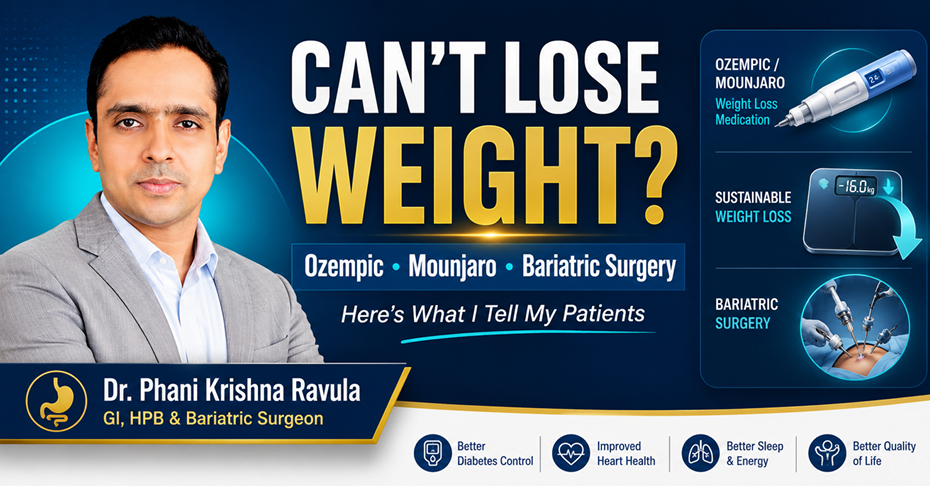
Ozempic vs Mounjaro vs Bariatric Surgery: Which Is Best for Weight Loss?
Ozempic, Mounjaro or Bariatric Surgery?
Here's What I Tell My Patients About
Weight Loss
One of the most common problems I see in my clinic today is obesity.
Almost every week, I meet patients who tell me the following:
"Doctor, I'm eating less."
"Doctor, I'm walking every day."
"Doctor, I've tried every diet on the internet."
And yet, despite their best efforts, the weight simply refuses to come down.
At the same time, many of these patients are also struggling with diabetes, high blood pressure,
fatty liver, sleep apnea, joint pains, or cholesterol problems.
Naturally, the next question they ask is the following:
"Doctor, should I try Ozempic or Mounjaro? Or do I need bariatric surgery?"
The answer is not the same for everyone.
First Things First: Diet and Exercise Are Still the Foundation
Before we discuss medications or surgery, I always remind my patients that there is no shortcut
around healthy habits.
Weight loss starts with:
● Reducing sugars
● Cutting down processed foods
● Avoiding junk food
● Increasing fiber intake
● Staying physically active
For many people, these measures alone are enough.
However, there is a group of patients who do everything correctly and still struggle with weight
loss. These are the patients who may benefit from additional treatment.
The New Weight Loss Drugs Everyone Is Talking About
Over the last few years, two names have dominated conversations about weight loss:
Mounjaro (Tirzepatide)
and
Ozempic (semaglutide).
Many patients come to my clinic asking specifically about these drugs because they have heard
about them from friends, social media, celebrities, or news reports.
These medications were originally developed to treat diabetes, but doctors soon realised that
they also helped patients lose significant amounts of weight.
How Do These Drugs Actually Work?
I usually explain it to my patients in very simple terms.
These medicines work by helping the body feel full earlier and stay full longer.
They:
✔ Improve insulin sensitivity
✔ Reduce sugar production by the liver
✔ Slow stomach emptying
✔ Reduce appetite
✔ Decrease cravings
As a result, patients naturally eat less without constantly feeling hungry.
How Much Weight Can You Realistically Lose?
This is probably the most common question I hear.
Based on current evidence and real-world experience, patients can lose approximately:
10% to 20% of their total body weight.
For an 80 kg person, this could mean losing anywhere from:
8 to 16 kilograms.
Of course, results vary depending on lifestyle, medication dose, and individual response.
What Patients Like About These Drugs
One of the biggest advantages is obvious.
There is no surgery.
Many patients prefer trying medication before considering an operation.
Interestingly, some patients also report:
● Reduced alcohol cravings
● Reduced smoking cravings
● Better control over food cravings
Research is still ongoing, but these observations are certainly encouraging.
What I Warn Patients About
No medication is perfect.
The most common side effects I see are gastrointestinal.
Patients may experience:
● Nausea
● Bloating
● Heartburn
● Diarrhea
● Abdominal discomfort
Most patients tolerate these symptoms reasonably well.
However, a small percentage find the side effects troublesome enough to stop treatment.
Another important issue is cost.
Many patients are surprised when they realise that treatment may cost around ₹20,000 per
month.
The Question Nobody Can Fully Answer Yet
One question I hear repeatedly is the following:
"Doctor, if I stop the injections, will I gain all the weight back?"
The honest answer is that we are still learning.
Some patients maintain their weight loss successfully after stopping treatment, especially if
they continue healthy lifestyle habits.
Others regain weight.
This is one reason why long-term follow-up remains important.
When Do I Recommend Bariatric Surgery?
As a GI surgeon, this is where my perspective becomes important.
There is no competition between weight loss drugs and bariatric surgery.
They are simply tools for different situations.
For patients with:
● BMI below 40
● Class 1 obesity
● Class 2 obesity
I generally believe medications deserve a fair trial first.
However, when I see patients with the following:
● BMI above 40
● Severe obesity
● Multiple obesity-related diseases
Then bariatric surgery becomes a very serious consideration.
Why Bariatric Surgery Is Still the Most Powerful Treatment
Unlike medications, bariatric surgery is usually a one-time procedure.
The results are often dramatic.
Many patients experience:
✔ Significant weight loss
✔ Diabetes remission
✔ Better blood pressure control
✔ Improvement in sleep apnea
✔ Better quality of life
In many patients, these changes can be life-changing.
My Personal Approach
When patients ask me whether Ozempic, Mounjaro, or bariatric surgery is better, I tell them
there is no universal answer.
If your obesity is mild to moderate, medications may be an excellent first step.
If your obesity is severe and affecting your health significantly, bariatric surgery often provides
the most durable and effective results.
The key is choosing the right treatment for the right patient.
Final Message to My Patients
Whether you choose:
● Diet and exercise
● Weight loss medications
● Bariatric surgery
There is one thing that never changes.
You must address:
● Junk food
● Sugary foods
● Excess alcohol
● Sedentary lifestyle
No drug and no surgery can permanently overcome unhealthy habits.
The most successful patients I see are not those who choose the most expensive treatment.
They are the ones who commit to long-term lifestyle change.
And that remains the true secret of successful weight loss.
— Dr Phani Krishna Ravula
GI, HPB & Bariatric Surgeon