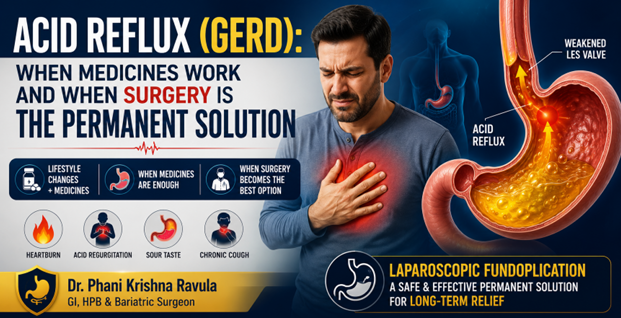
Acid Reflux Treatment: When Are Medicines Enough and When Is Surgery the Permanent Solution?
Acid Reflux: Do You Need Medicines for
Life or Is There a Permanent Solution?
One of the most common questions I hear in my clinic is:
"Doctor, I've been taking acidity tablets for years. Is there a permanent
solution?"
The answer is…
It depends on what's causing your acid reflux.
Some patients can control their symptoms with medicines and simple lifestyle changes.
Others have a structural problem that medicines cannot fix. In those cases, surgery may provide
long-term relief.
Let me explain.
What Is Acid Reflux?
Normally, food travels from your food pipe (oesophagus) into your stomach through a valve
called the Lower Oesophageal Sphincter (LES).
This valve opens to let food in and then closes tightly to stop stomach contents from flowing
back.
When this valve becomes weak or loose, stomach acid flows back into the food pipe.
This is called acid reflux, also known as GERD (Gastroesophageal Reflux Disease).
Common Symptoms of Acid Reflux
Patients may experience:
● Burning sensation in the chest (heartburn)
● Sour or bitter taste in the mouth
● Regurgitation of food
● Frequent burping
● Chest discomfort after meals
● Night-time reflux
● Chronic cough
● Hoarseness of voice
● Difficulty swallowing in some cases
Many people ignore these symptoms, assuming they're just "gas problems."
Persistent reflux should never be ignored.
The First Step Is an Endoscopy
When someone comes to me with long-standing reflux symptoms, I usually recommend an
upper GI endoscopy.
This helps us examine:
● The food pipe
● The stomach
● The junction between them (Gastroesophageal Junction or GE Junction)
This is important because not every patient with reflux needs surgery.
If the Endoscopy Is Normal...
Many patients are relieved to hear that their endoscopy is completely normal.
In these cases, the valve is usually still functioning reasonably well.
Most patients improve with:
● Proton Pump Inhibitors (PPIs)
● Lifestyle changes
● Dietary modifications
Common medicines include:
● Pantoprazole
● Omeprazole
● Esomeprazole
These medicines reduce acid production and allow the food pipe to heal.
Lifestyle Changes Make a Big Difference
Medicines alone are not enough.
I always advise patients to make a few important lifestyle changes.
These include:
● Avoid deep-fried and oily foods
● Reduce spicy foods if they trigger symptoms
● Avoid large heavy meals
● Eat dinner at least 2–3 hours before bedtime
● Reduce alcohol consumption
● Stop smoking
● Limit tea, coffee, and citrus juices if they worsen symptoms
● Maintain a healthy body weight
For many patients, these changes significantly reduce reflux episodes.
Do You Need to Take Medicines Forever?
Not always.
I usually prescribe medicines for around 8 weeks initially.
Once symptoms improve, many patients can stop regular medication.
If symptoms return occasionally, they can use medicines only when needed under medical
guidance.
This is called on-demand therapy.
When Is Surgery Needed?
Some patients continue to suffer despite taking medicines regularly.
In these patients, the problem is often mechanical, not just chemical.
During endoscopy, we sometimes find that the valve between the food pipe and stomach has
become loose.
This is graded using the Hill Classification.
Patients with:
● Hill Grade III
● Hill Grade IV
often have significant valve weakness.
What Is a Hiatus Hernia?
Another common finding is a hiatus hernia.
This happens when part of the stomach slips upward through the diaphragm into the chest.
When this occurs:
● The valve cannot close properly.
● Acid keeps flowing back into the food pipe.
● Medicines reduce acid but cannot repair the faulty valve.
This is why some patients continue to have symptoms despite long-term medication.
Why Medicines Alone May Not Be Enough
Acid-reducing medicines only reduce the amount of acid produced.
They do not stop stomach contents from coming back up.
Other digestive fluids can also reflux, including:
● Bile
● Digestive enzymes
● Food particles
These can continue to irritate the food pipe even when acid production is reduced.
That's why some patients experience only partial relief with medicines.
The Permanent Solution: Laparoscopic
Fundoplication
For patients with:
● Severe GERD
● Loose GE junction
● Hiatus hernia
● Persistent symptoms despite medicines
the best long-term option may be Laparoscopic Fundoplication.
During this minimally invasive surgery, the upper part of the stomach is wrapped around the
lower food pipe to strengthen the valve.
This restores the natural barrier that prevents reflux.
Is Laparoscopic Fundoplication Safe?
Yes.
It is a well-established minimally invasive procedure performed worldwide.
The surgery offers several advantages:
● Small incisions
● Less pain
● Faster recovery
● Short hospital stay
● Excellent long-term symptom control
When performed by an experienced GI and laparoscopic surgeon, the outcomes are very good.
Who Should Consider Surgery?
You may benefit from surgery if:
● Medicines no longer control your symptoms.
● You need acid-suppressing tablets for years.
● Endoscopy shows a loose GE junction.
● You have a hiatus hernia.
● Your quality of life is affected by persistent reflux.
The decision is always individual and should be made after a detailed evaluation.
My Advice to Patients
Whenever someone asks me,
"Doctor, can acid reflux be cured permanently?"
I tell them that the answer depends on the cause.
If the valve is still functioning well, medicines and lifestyle changes are often enough.
But if the valve has become permanently weak or a hiatus hernia is present, medicines can only
control the symptoms—not correct the underlying problem.
For the right patient, laparoscopic fundoplication offers a safe and effective long-term solution
that restores the natural anti-reflux mechanism and significantly improves quality of life.
— Dr. Phani Krishna Ravula
GI, HPB & Bariatric Surgeon