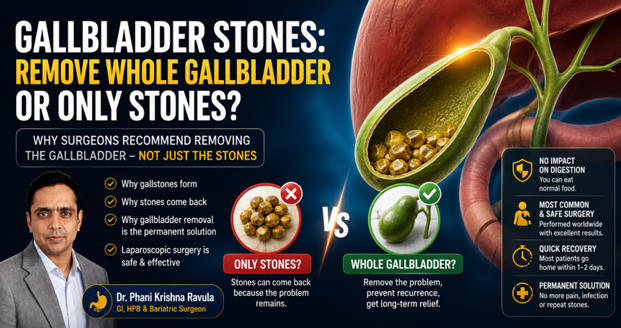
Gallbladder Stones: Why Do Surgeons Remove the Gallbladder Instead of Just the Stones?
Why Do We Remove the Entire Gallbladder
Instead of Just the Stones?
One of the most common questions I hear from patients is:
"Doctor, can't you just remove the gallstones and leave my gallbladder
behind?"
It's a very reasonable question.
Many people compare gallstones with kidney stones and assume the treatment should be the
same.
But the truth is...
Gallstones and kidney stones are completely different diseases.
Let me explain why.
Kidney Stones and Gallstones Are Not the Same
With kidney stones, the kidneys are usually healthy.
The stones develop because minerals like calcium or oxalate accumulate and form crystals.
Since the kidneys are vital organs, we always try to preserve them and remove only the stones
whenever possible.
The situation is completely different with gallstones.
Gallstones Are a Sign of a Diseased Gallbladder
Gallstones usually form because the gallbladder itself is no longer working properly.
Instead of emptying bile efficiently, the gallbladder becomes sluggish.
When bile stays inside for too long, it becomes concentrated and eventually forms stones.
In other words:
The stones are not the real problem.
The gallbladder is.
Why Does the Gallbladder Become Weak?
Several conditions can reduce the normal contraction of the gallbladder.
Common causes include:
● Pregnancy
● Hormonal changes (especially progesterone)
● Diabetes
● Chronic constipation
● Previous viral infections
● Typhoid
● Dengue
● COVID-19
● Other illnesses affecting gallbladder function
Once the gallbladder stops emptying normally, stones begin to develop.
Can Ultrasound Tell Us This?
Yes.
An ultrasound not only shows the stones but often reveals that the gallbladder is functioning
poorly.
By the time gallstones become symptomatic, the gallbladder has usually already lost much of its
normal function.
Why Not Simply Remove the Stones?
Many decades ago, surgeons asked exactly the same question.
Several methods were tried, including:
● Dissolving gallstones with medicines
● Injecting chemicals into the gallbladder
● Opening the gallbladder and removing only the stones
Initially, these treatments appeared successful.
But there was one major problem.
The stones kept coming back.
Sometimes within just a few months.
Eventually, doctors around the world reached the same conclusion:
The problem wasn't the stones.
The problem was the diseased gallbladder.
Today's Standard Treatment
Today, the treatment is the same across the world.
Whether you're in:
● India
● Japan
● Europe
● The United States
the standard treatment for symptomatic gallstones is:
Laparoscopic removal of the entire gallbladder (Laparoscopic Cholecystectomy).
This removes both:
● The stones
● The organ responsible for forming them
Will My Digestion Be Affected?
This is another common concern.
Fortunately, the answer is no for most patients.
After gallbladder removal:
● You can eat a normal diet.
● You do not need lifelong dietary restrictions.
● Most people return to their regular routine within a few days.
The liver continues to produce bile normally.
The only difference is that bile flows directly into the intestine instead of being stored in the
gallbladder.
Can Gallstones Be Removed Through Endoscopy?
No.
Gallbladder stones cannot be treated with endoscopy.
However, if a stone escapes from the gallbladder and becomes lodged in the common bile
duct, an endoscopic procedure called ERCP may be required to remove that stone.
The gallbladder itself still needs to be removed laparoscopically to prevent future problems.
Is Gallbladder Surgery Safe?
Yes.
Laparoscopic gallbladder removal is one of the most commonly performed operations
worldwide.
It is:
● Minimally invasive
● Safe
● Effective
● Associated with quick recovery
When performed by an experienced laparoscopic GI surgeon, the results are excellent.
My Advice to Patients
Whenever someone asks me,
"Doctor, why can't you just remove the stones?"
I explain that the stones are only a symptom.
The real problem is a gallbladder that is no longer functioning properly.
Removing only the stones would simply allow new stones to form again.
That's why the standard treatment across the world is to remove the entire gallbladder—not just
the stones.
It offers the best long-term solution and helps prevent repeated attacks, infections, and
complications.
— Dr. Phani Krishna Ravula
GI, HPB & Bariatric Surgeon