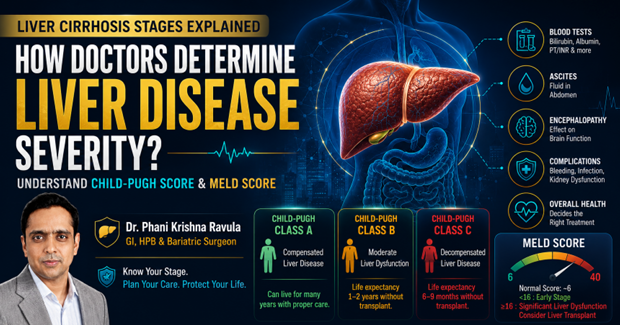
Liver Cirrhosis Stages Explained: What Are Child-Pugh and MELD Scores?
"Doctor, How Much of My Liver Is
Damaged?" – Here's How I Explain It to My
Patients
What Is the MELD Score?
What Is a Normal MELD Score?
One of the most common questions I hear from patients diagnosed with liver cirrhosis is:
"Doctor, what percentage of my liver is damaged?"
It's a completely understandable question.
Many people expect an ultrasound or scan to tell them exactly how much of the liver has
stopped working.
But here's something that surprises most patients:
There is no percentage that tells us how severe liver cirrhosis is.
Instead, we assess how well your liver is functioning, not just how damaged it looks on a
scan.
What Causes Liver Cirrhosis?
Liver cirrhosis is the final stage of long-term liver damage.
Some of the most common causes include:
● Hepatitis B
● Hepatitis C
● Excessive alcohol consumption
● Fatty liver disease (MASLD/NAFLD)
● Other chronic liver diseases
Although the causes are different, what matters most is how well the liver continues to
perform its vital functions.
An Ultrasound Doesn't Tell the Whole
Story
Many patients assume that an ultrasound can determine the exact stage of cirrhosis.
In reality, an ultrasound may show:
● A shrunken or irregular liver
● An enlarged spleen
● Fluid in the abdomen (ascites)
● Signs of portal hypertension
These findings are helpful, but they do not tell us how much liver function remains.
To understand that, we need blood tests and a clinical assessment.
How Do We Measure Liver Function?
When I evaluate a patient with liver cirrhosis, I look at several important factors, including:
● Bilirubin levels
● Albumin levels
● Blood clotting (Prothrombin Time/INR)
● Presence of fluid in the abdomen (ascites)
● Any effect on brain function (hepatic encephalopathy)
Using this information, we classify patients into three groups known as the Child-Pugh
Classification.
Child-Pugh Class A – Early Stage
Cirrhosis
Patients with Child-Pugh A have cirrhosis, but their liver is still functioning reasonably well.
Many people in this stage:
● Feel relatively well
● Continue their normal daily activities
● Can live for many years with appropriate treatment and follow-up
This is why early diagnosis is so important.
Child-Pugh Class B – Moderate Liver
Damage
In Child-Pugh B, the liver begins to lose its ability to function effectively.
Patients may develop complications such as:
● Fluid accumulation in the abdomen
● Fatigue
● Reduced appetite
● Swelling in the legs
● Bleeding risks
At this stage, I usually begin discussing liver transplantation with patients and their families, so
they understand the options before the disease progresses further.
Child-Pugh Class C – Advanced Liver
Failure
This is the most severe stage of liver cirrhosis.
Patients often have significant liver dysfunction along with complications such as:
● Severe jaundice
● Ascites
● Confusion due to hepatic encephalopathy
● Kidney dysfunction
● Frequent hospital admissions
Without a liver transplant, survival is often limited.
For these patients, early referral for liver transplantation can be life-saving.
What Is the MELD Score?
Another important number you may hear during your consultation is the MELD Score, which
stands for:
Model for End-Stage Liver Disease
Unlike the Child-Pugh classification, the MELD score is calculated using blood test results.
It helps us estimate:
● The severity of liver disease
● The risk of complications
● Whether a patient may benefit from liver transplantation
What Is a Normal MELD Score?
A healthy person usually has a MELD score of around 6.
As liver disease worsens, the score increases.
In general:
● Below 16 – Early liver disease, usually managed with regular follow-up and treatment.
● 16 or above – Significant liver dysfunction. This is often the point where we begin evaluating patients for a liver transplant, depending on their overall condition.
The higher the MELD score, the more urgently a patient may need advanced treatment.
Why Early Evaluation Matters
One mistake I often see is patients waiting until they become very sick before seeking specialist
care.
By the time symptoms become severe, treatment options may be more limited.
If you have:
● Chronic hepatitis B or C
● Fatty liver disease
● Alcohol-related liver disease
● Persistent jaundice
● Swelling of the abdomen or legs
please don't wait until complications develop.
Early evaluation allows us to monitor your liver, manage complications, and determine the right
time for interventions such as liver transplantation.
My Advice to Patients
Whenever someone asks me,
"Doctor, how damaged is my liver?"
I explain that the most important question isn't how damaged it looks, but how well it's still
working.
That's why we use the Child-Pugh classification and MELD score—they help us understand
the liver's function and guide the best treatment plan.
The earlier we assess liver disease, the more options we have to protect your health and
improve your long-term outcome.
— Dr. Phani Krishna Ravula
GI, HPB & Bariatric Surgeon