Inguinal Hernia Treatment: When Surgery Is Necessary and When It Isn’t
Inguinal hernia — commonly called a groin hernia — is one of the most frequent surgical
problems seen worldwide. While many people notice a swelling in the groin and panic about
surgery, the truth is more nuanced.
👉 Not every inguinal hernia needs immediate surgery — but many do.
Understanding who needs treatment and who can be safely observed is the key.
What Is an Inguinal Hernia?
An inguinal hernia occurs when there is a weakness or gap in the abdominal muscles, allowing
internal contents such as intestine or abdominal fat (omentum or mesentery) to protrude
outside the abdominal cavity into the groin area.
This appears as a swelling in the groin, which may sometimes extend into the scrotum.
Why Do Inguinal Hernias Occur?
1. Developmental (Congenital) Cause
During fetal development, the testes move from inside the abdomen into the scrotum through a
passage called the inguinal canal. In some individuals, this passage does not close completely
(called patent processus vaginalis).
➡ Over years, this weakness can lead to an indirect inguinal hernia.
2. Acquired Causes
In others, hernias develop due to increased abdominal pressure, such as:
● Chronic cough (especially in smokers)
● Constipation and straining
● Enlarged prostate
● Obesity
● Heavy lifting
These factors weaken the abdominal muscles and precipitate hernia formation.
Symptoms of Inguinal Hernia
Common symptoms include:
● A groin swelling that appears while standing or walking
● Swelling that disappears on lying down (early stage)
● Dragging pain or discomfort in the groin
● A feeling of weakness or insecurity in the groin
As the hernia progresses, the swelling may extend into the scrotum and become permanent.
Dangerous Complications You Should Know About
An inguinal hernia can sometimes become stuck (irreducible hernia) or lose its blood supply
(strangulated hernia).
Warning signs of an emergency:
● Sudden severe pain
● Redness and tenderness over the swelling
● Vomiting
● Abdominal distension
● Inability to pass stools
If untreated, this can lead to gangrene of the intestine, sepsis, and even death.
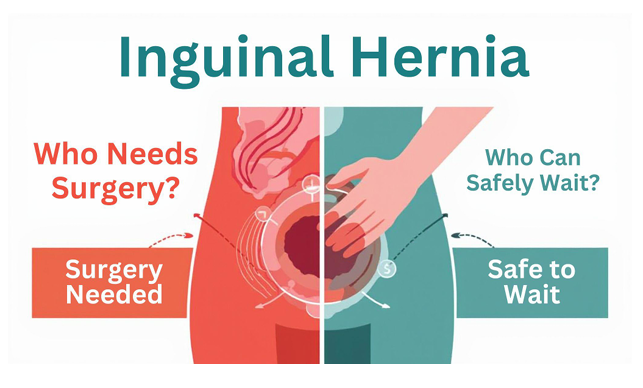
Who Needs Surgery for Inguinal Hernia?
Surgery is strongly recommended in:
● All indirect inguinal hernias
● All symptomatic hernias
● Younger patients, even if symptoms are mild
Why?
Hernias never heal on their own and only increase in size over time, raising the risk of
complications.
Who May Not Need Immediate Surgery?
Only selected patients can be safely observed:
● Very elderly patients (around 70–75 years and above)
● Small direct inguinal hernias
● No symptoms
These patients can be managed with watchful waiting and regular follow-up.
What About Hernias Found on Ultrasound?
Sometimes, a very small or occult hernia is detected incidentally on ultrasound without
symptoms.
➡ In such cases, surgery is not advised immediately.
➡ Surgery is recommended only if symptoms develop.
What Is the Best Treatment for Inguinal Hernia?
Medicines, belts, and alternative therapies do NOT cure hernias.
An inguinal hernia is a mechanical defect, and therefore needs a mechanical solution.
Gold standard treatment: Tension-Free Mesh Repair
● The weak area is reinforced with a permanent mesh
● The mesh acts as a scaffold for tissue growth
● This significantly reduces recurrence
Open vs Laparoscopic Hernia Surgery
While open surgery has been performed for decades, laparoscopic hernia repair is now
considered the standard of care.
Advantages of laparoscopic repair:
● Tiny keyhole incisions (5 mm)
● Less pain after surgery
● Faster recovery
● Early return to work (often within 1–2 days)
● Lower risk of chronic nerve pain
● Better cosmetic results
● Ability to repair both sides through the same incisions
For large direct or indirect hernias, laparoscopy allows placement of a larger mesh, which is not
possible with open surgery.
Final Takeaway
✔ Inguinal hernias are common
✔ They do not heal on their own
✔ Most patients need surgery
✔ A small group of elderly, asymptomatic patients can wait
✔ Laparoscopic mesh repair offers the best outcomes
The right decision depends on the right diagnosis, patient profile, and surgical expertise —
not fear.