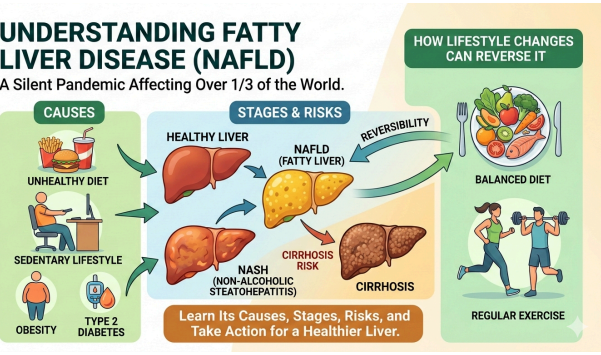
Fatty Liver Disease (NAFLD): Causes, Stages, Risks & How to Reverse It
Fatty Liver Disease — The Silent Pandemic
Today, most people are familiar with the word "pandemic". A pandemic refers to a disease that affects large populations across the world regardless of age, gender, or race.
However, there is another pandemic quietly spreading across the globe over the past three decades — one that many people are still unaware of.
Doctors now refer to fatty liver disease, particularly non-alcoholic fatty liver disease (NAFLD), as a silent pandemic.
Unlike infectious pandemics that spread rapidly and show immediate symptoms, fatty liver disease develops slowly and silently over 10–20 years. During this time, the liver gradually accumulates fat, and damage progresses without obvious warning signs.
Because of its massive prevalence and long-term health consequences, experts believe that fatty liver disease could eventually impact far more people than many infectious diseases.
How Common Is Fatty Liver Disease?
Fatty liver disease has become extremely common worldwide.
Scientific studies suggest:
● More than one-third of the world’s population may have fatty liver disease.● In urban populations, the prevalence may reach 40–50%.● In many communities, 1 out of every 3 people may have fatty liver.
Despite these numbers, most people remain completely unaware of the condition.
What Exactly Is Fatty Liver?
Fatty liver occurs when fat accumulates inside the liver cells (hepatocytes).
Normally, the liver contains very little fat. But when more than 5% of liver cells contain fat, the condition is classified as fatty liver disease.
An abdominal ultrasound usually detects fatty liver only when approximately 30% of liver cells contain fat deposits.
Because fatty liver often causes no symptoms, it is frequently discovered incidentally during routine ultrasound examinations.
Why Is It Called Non-Alcoholic Fatty Liver Disease (NAFLD)?
Fatty liver can occur due to alcohol consumption, certain medications, or metabolic diseases.
However, in the majority of modern patients, fatty liver develops without alcohol consumption.
This form is called the
NAFLD — Non-Alcoholic Fatty Liver Disease
NAFLD is primarily a diet and lifestyle-related disease.
What Causes Fatty Liver Disease?
Fatty liver disease is closely associated with metabolic syndrome, a group of risk factors that often occur together.
These include:
● Insulin resistance● Type 2 diabetes● High triglycerides● High LDL cholesterol● Low HDL cholesterol● High blood pressure● Central obesity
When these conditions occur together, the body stores excess fat in the liver.
Lifestyle Factors Driving the Fatty Liver Pandemic
Modern lifestyle habits play a major role in the rise of fatty liver disease.
Some major contributing factors include:
• Excess calorie intake
• Diets rich in refined carbohydrates
• Processed foods made from wheat, maida, and rice flour
• Sugary beverages and sweets
• Sedentary lifestyle
• Lack of physical activity
When the body consumes more calories than it burns, excess fat begins accumulating in the liver.
Fatty Liver and Other Serious Diseases
Fatty liver disease rarely occurs alone. It is closely linked to several serious health conditions.
These include:
● Type 2 diabetes● Coronary artery disease● Heart attacks● Stroke● Polycystic ovarian syndrome (PCOS)
Metabolic syndrome and fatty liver disease are also associated with an increased risk of certain cancers, including the following:
● Colon cancer● Pancreatic cancer● Endometrial cancer
Understanding the Disease Progression
Fatty liver disease does not always remain harmless. In some patients it progresses through several stages.
Stage 1 — Simple Fatty Liver (Steatosis)
Fat accumulates inside liver cells.
At this stage:
● The condition may be reversible● Many patients have no symptoms
Stage 2 — NASH (Non-Alcoholic Steatohepatitis)
In some patients, fatty liver progresses to NASH.
NASH causes:
● Liver inflammation● Liver cell injury● Progressive scarring
Studies show:
● 8–16% of fatty liver patients may develop NASH
Stage 3 — Liver Fibrosis
Persistent inflammation leads to scarring of liver tissue.
This stage indicates ongoing liver damage.
Stage 4 — Liver Cirrhosis
Extensive scarring leads to cirrhosis, where normal liver tissue is replaced by scar tissue.
Cirrhosis may lead to:
● Liver failure● Liver cancer● Need for liver transplantation
Studies show that around 10% of NASH patients may develop cirrhosis over a decade.
Because of this progression, NAFLD is expected to become one of the leading causes of liver transplantation worldwide.
How Is Fatty Liver Detected?
Fatty liver is commonly detected during the following:
● Routine ultrasound scans● Annual health check-ups● Abnormal liver function tests
Because symptoms are usually absent, regular screening becomes very important, especially in patients with obesity or diabetes.
Medical Evaluation for Fatty Liver
Patients suspected to have fatty liver disease may undergo:
● Liver function tests● Abdominal ultrasound● Elastography to assess fibrosis● Liver biopsy in selected cases
Some patients with documented chronic liver disease require periodic monitoring every 6 months, including screening for complications.
Can Fatty Liver Be Treated?
The good news is that fatty liver disease is often reversible, especially in its early stages.
Currently, no single medication can completely cure NAFLD.
Although some drugs like vitamin E and PPAR agonists may reduce inflammation, the most effective treatment remains lifestyle modification.
The Most Effective Way to Reverse Fatty Liver
The only proven effective way to reverse NAFLD is through dietary and lifestyle changes.
Healthy Diet
A balanced diet should include:
● Vegetables● Fruits● Lean proteins● Whole grains● Foods with a low glycemic index
Patients should reduce:
● Sugary foods
● Refined carbohydrates
● Processed foods● Excess calorie intake
Physical Activity
Regular exercise helps reduce liver fat and improves metabolic health.
Activities such as:
● Brisk walking● Cycling● Strength training● Swimming
can significantly improve liver health.
Weight Reduction
Patients with obesity should aim for gradual and sustained weight loss.
Even a 5–10% reduction in body weight can significantly improve fatty liver disease.
Patients with a BMI greater than 32.5, especially those with associated conditions like diabetes or dyslipidaemia, may sometimes benefit from bariatric surgery.
What Patients Should Remember
Fatty liver disease may not cause symptoms in the beginning, but it should never be ignored.
It serves as a warning signal from your body that lifestyle changes are needed.
With early diagnosis and appropriate lifestyle modifications, fatty liver disease can often be reversed before permanent damage occurs.
About the Author
Dr. Phani Krishna Ravula
Consultant Surgical Gastroenterologist
GI Cancer & Liver Transplant Surgeon
Dr. Phani Krishna Ravula specialises in minimally invasive gastrointestinal surgery, hepatobiliary surgery, and advanced liver disease management.
He regularly treats conditions involving:
● Liver diseases● Gallbladder disorders● Pancreatic diseases● Hernias● Gastrointestinal cancers
His approach focuses on early diagnosis, evidence-based treatment, and patient education to prevent serious complications.